

The hidden cost of stop-start marketing
If your marketing only springs into action when a major project kicks off, a new service launches or sales begin to slow, you’re not alone.
Many organisations find themselves caught in a cycle of reactive marketing.
Priorities shift, internal resources are stretched and marketing often becomes something that’s switched on when needed, then paused when other business demands take over.
The challenge is that your customers don’t make decisions on the same timeline as you.
Whether they’re researching solutions, comparing providers or building confidence in your expertise, buying decisions often happen over weeks or months. The organisations that stay visible throughout that journey are far more likely to be considered when the time comes to engage.
Rather than starting from zero with every campaign, you’re building momentum that compounds overtime. The businesses achieving sustainable growth aren’t necessarily spending more on marketing. They’re investing more consistently.
The problem with stop-start marketing
Reactive marketing feels productive because it responds to immediate business needs.
You launch a campaign before an event, refresh your website ahead of an important opportunity or publish content after completing a successful project. While these activities have value individually, they rarely create lasting momentum.
Instead, marketing becomes a cycle of catching up rather than getting ahead.
It increases your marketing costs
Starting and stopping marketing is rarely efficient.
Every new campaign requires planning, creative development, approvals and setup. Teams spend valuable time rebuilding momentum instead of improving what already exists.
Without ongoing optimisation, campaigns often begin from scratch rather than building on previous learnings. The result is higher acquisition costs, duplicated effort and lower returns on your marketing investment.
You miss opportunities you never knew existed
Potential customers are researching long before they make contact.
They’re comparing providers, exploring solutions, reading case studies and looking for evidence that a business understands their challenges.
If your organisation isn’t consistently visible during this research phase, you may never make the shortlist. Being absent from the conversation often means missing opportunities before you’re even aware they existed.
You lose momentum
Marketing works best as a compounding investment.
Search rankings improve through consistent content. Brand awareness grows through repeated exposure. Customer relationships strengthen through regular communication.
When activity pauses, much of that momentum begins to decline.
Your website traffic slows, engagement drops and lead generation becomes less predictable. But while you’ve paused, your competitors continue strengthening their market presence.
Once momentum is lost, rebuilding it takes far more time and effort than maintaining it.
Why always-on marketing delivers better results
Always-on marketing doesn’t mean constantly running expensive campaigns or producing content every day. It means creating a consistent, strategic presence that supports your business goals and keeps you connected with your audience throughout the entire customer journey.
Rather than waiting for opportunities to appear, always-on marketing creates the visibility, credibility and relationships that make opportunities more likely to find you.
Think of always-on marketing as the SCADA system for your growth pipeline.
SCADA systems provide continuous visibility into complex operations, monitoring performance, identifying potential issues early and enabling informed decisions based on real-time data.
Always-on marketing applies the same principles. It continuously monitors market signals, customer behaviour and engagement, providing the insights needed to refine your approach, respond to opportunities and maintain momentum.
Just as critical systems perform best when they are monitored and optimised continuously, your marketing performs best when it is always active, measured and improving.
Drive scalable and sustainable growth
Consistent marketing aligns with long-term business objectives rather than short-term activity. For Tetra Tech,
Whether your goal is expanding into new markets, attracting larger clients, launching new services or strengthening your reputation, an always-on approach builds awareness before you need immediate results.
Build visibility, trust and long-term lead generation
Expertise alone isn’t enough if potential customers don’t know you exist.
Consistent thought leadership, customer stories, project updates and educational content demonstrate credibility over time, helping build trust long before a sales conversation begins.
Trust is rarely built through a single campaign, brochure or email.
It’s built through repeated, valuable interactions.
Learn what works and optimise continuously
Marketing shouldn’t rely on assumptions.
An always-on approach creates continuous opportunities to test messaging, channels, creative, audiences and offers.
Rather than asking whether marketing works, you begin understanding exactly what works and why. These insights compound over time, making every future campaign more effective.
Stay agile and relevant
Markets change quickly.
New opportunities, industry trends, customer needs and business priorities create ongoing opportunities to communicate with your audience. Organisations with established marketing systems can respond faster because the foundations are already in place.
Generate stronger long-term returns
Consistent marketing creates assets that continue delivering value.
Content attracts search traffic long after publication. Case studies support sales conversations. Email databases grow. Brand awareness compounds.
Instead of repeatedly paying to regain attention, you’re building long-term marketing equity that continues delivering results.
How to transition from reactive to proactive always-on marketing
Moving towards an always-on strategy doesn’t require a complete marketing overhaul.
It starts with building systems that encourage continuous improvement.
1. Create a testing and optimisation framework
Rather than launching isolated campaigns, establish a process for ongoing experimentation.
Define clear goals
Separate short-term objectives from long-term business outcomes.
For example:
- Generate qualified enquiries for a new service
- Increase website traffic from your target audience
- Improve conversion rates on key landing pages
- Strengthen brand awareness in your market.
Whatever your goals, it’s essential to define how success will be measured before any activity begins.
Establishing clear metrics from the outset creates accountability, provides a benchmark for performance and ensures every marketing initiative can be evaluated against meaningful business outcomes.
Build and prioritise your marketing pipeline
Your best ideas often come from across the business.
Collect suggestions from sales, customer service, operations, leadership and subject matter experts. Prioritise ideas based on business impact, effort and alignment with strategic goals.
This creates a pipeline of marketing initiatives to test rather than relying on last-minute requests.
Test one variable at a time
Every marketing activity should be designed to answer a specific question.
Rather than changing multiple elements at once, test a single variable so you can clearly identify what is driving performance.
For example, compare whether a customer case study generates more engagement than a service overview. Identify which audience segment responds best. Measure whether video outperforms static imagery or determine which call-to-action leads to more enquiries.
By testing one variable at a time, you gain meaningful insights that can be applied to future campaigns, improving performance with every iteration.
Review results regularly
Marketing should evolve continuously.
Review performance against predefined success metrics and identify activities worth scaling.
Successful experiments become part of your always-on marketing program, while underperforming initiatives provide valuable learning without significant risk.
2. Align marketing with your customer’s journey
Many organisations invest heavily in lead generation but spend far less effort supporting customers throughout the rest of their journey. Purchasing decisions are rarely immediate. Clients move through several stages as they become aware of your business, build confidence in your expertise, evaluate their options, make a purchase and, ideally, become loyal advocates.
Marketing should be aligned to each of these stages.
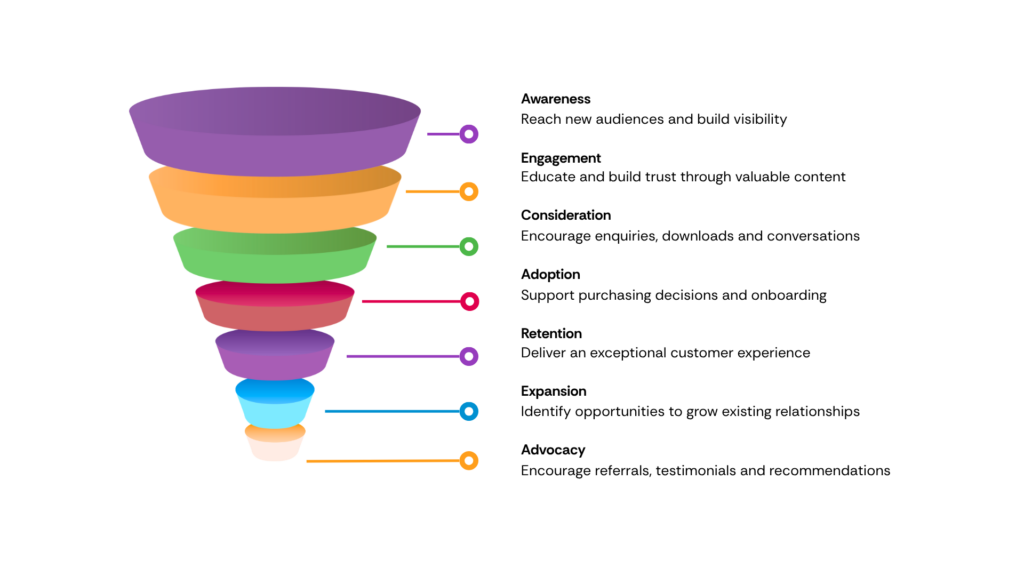
Mapping your marketing activities across the entire customer journey ensures you’re delivering the right message at the right time. Rather than concentrating solely on generating leads, you create a consistent experience that builds trust, strengthens relationships and maximises customer lifetime value.
3. Balance reactive and proactive communication
Not every piece of communication can be planned.
Business announcements, customer success stories, industry news and timely updates all deserve a quick response. However, these should complement your long-term marketing strategy, not replace it.
Think of reactive marketing as tactical – responding to opportunities in the moment.
And think of proactive marketing as strategic – intentionally build towards your long-term goals.
Both have a place, but sustainable growth depends on maintaining the right balance.
4. Digitise and automate your marketing and sales where possible
Marketing technology allows teams to achieve more with fewer resources.
Consider automating:
- Email nurture campaigns
- Customer onboarding
- Event follow-up
- Lead scoring
- Reporting dashboards
- Social media scheduling
- Customer feedback requests
Automation reduces manual effort while creating more personalised customer experiences.
5. Turn your marketing into a source of business intelligence
Every interaction provides valuable data.
Website behaviour, campaign performance, CRM insights and customer feedback reveal what your audience is interested in and where they’re encountering barriers. Over time, these insights help refine messaging, improve customer experiences and support smarter business decisions.
The more consistently you collect data, the more confident your future decisions become.
Build momentum, not just campaigns
The most successful organisations don’t treat marketing as something they switch on when they need leads.
They treat it as an ongoing business capability that compounds over-time. This builds visibility, strengthens trust and creates opportunities over time.
An always-on approach keeps your brand present, your audience engaged and your strategy moving forward, so you’re ready to act when opportunities arise.
Instead of starting from zero with every campaign, you’re building a foundation that delivers a greater impact and more consistent return on your marketing investment.
Get in contact with Focused Marketing to turn your marketing from a series of campaigns into a system that drives ongoing growth.