

You’ve just finished creating a social media post.
The copy is accurate. The design looks good. The spelling has been checked. The brief has been followed. So naturally, it seems like it’s ready to send back to your stakeholders to review or hit post.
But before you do any of that, there’s one question you need to ask first:
So what?
This isn’t a criticism of what you’ve made, and it doesn’t mean something is wrong with it. Think of it as a final check before it leaves your hands. Because there’s no point sending something out into the world, if it isn’t going to make an impact once it’s there.
Why “correct” and “good” are no longer the same thing
Because AI can produce something that looks good from afar but is far from good.
AI has made it easier than ever to create content, but its output is best treated as a prototype, not a finished piece. While AI is great at grammatical accuracy and structural coherence, its output often follows a formulaic approach that lacks the nuances of human writing.
That means taking a red pen to it: questioning the wording, sharpening the message and making sure it reflects your brand voice and speaks directly to your audience.
In a digital world crowded with AI-generated content, being technically correct is no longer enough.
So, what does this mean?
Technically, 2 + 2 = 4
There’s nothing wrong with that answer. It’s correct.
But if those numbers represented money you needed to put aside for an expense, correct wouldn’t be enough. You’d need to know what the numbers stood for and what the calculation was actually being used for.
Technically, a social media post can accurately list every service a business offers
It could use the correct terminology, follow the brand guidelines, contain no spelling mistakes and look great.
But if you don’t know who you’re talking to, why you’re talking to them or what you’re trying to achieve, you don’t know whether it’s a good post. And that’s the difference.
So, then, what does being good mean?
Being good is about understanding why you’re being asked the question in the first place. It’s not just about getting the answer right.
With the maths example, good means understanding what the calculation is being used for. And with the marketing example, good means understanding the audience, the purpose and the bigger strategy, and then creating something that aligns with all three.
Correct tells you that something is accurate. Good asks whether it’s right.
And that’s where the question “So what?” comes in.
Taking a structured approach to “So what”
“So what?” is a simple check that forces you to look beyond why you’re doing something in the first place, and question whether what you’ve produced is fit for purpose.
Here are six checks worth making before you publish something. Question if it is:
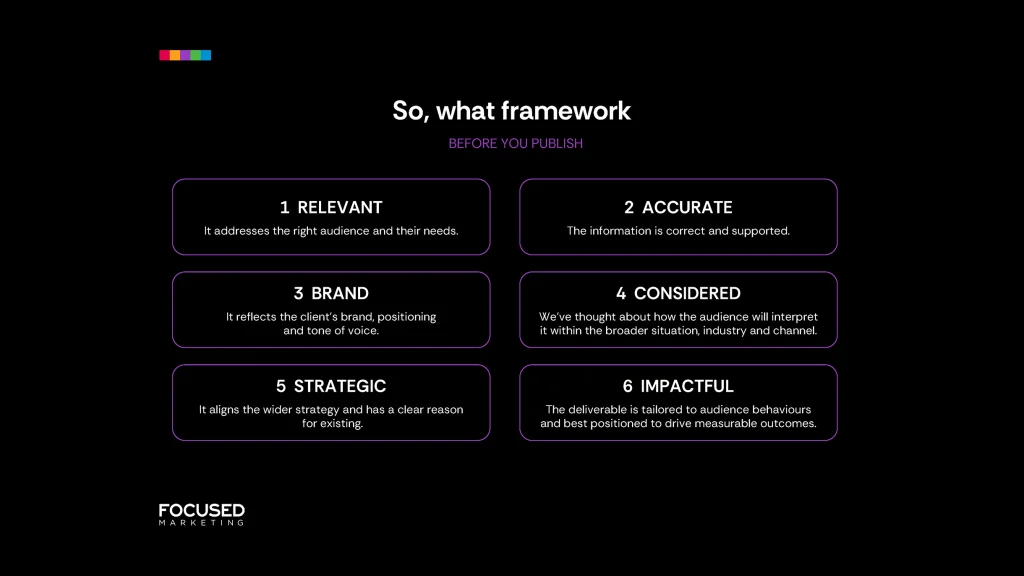
Content for the sake of content isn’t the goal. Every piece of work you produce should have a reason for existing. It should be helping you communicate, solve a problem, influence a decision, change a behaviour or move you towards an outcome.
If you don’t know what that reason is, you’re producing something and hoping it works. “So what?” makes you stop hoping and start thinking.
Let’s go back to that social media post
Imagine a stakeholder sends through a brief:
“Can you please create a social media post highlighting the services displayed on our website?”
Technically, there’s enough information here to create a post. But is there enough information to create a good post? Not really.
- Who is the post targeting?
- Why are you talking about these services?
- What are you trying to communicate?
- What does the audience need to know?
- What are you trying to achieve?
Without those answers, you can’t assess whether the post is relevant. And if you can’t establish relevance, it’s much harder to create work for impact.
So you go back to the stakeholder. You ask more questions. Sometimes they don’t know the answers. And that’s OK. Part of your job is to help them find out.
The goal is to understand what you’re trying to achieve, then work out the best way to get there.
The person reviewing needs to understand the why too
You can’t review an answer if you don’t know the question. It’s the same as marking an assignment without the marking criteria. You might be able to spot spelling mistakes or suggest a better way to phrase something, but you can’t judge whether the piece is doing what it’s supposed to do.
The person reviewing the deliverable needs the same context as the person creating it. Without the why, you’re reviewing against your own interpretation of what the piece should be doing, rather than what it was intended to achieve.
And that’s when things can get confusing. You can end up making changes that move the piece further away from its purpose, simply because the purpose was never clear in the first place.
Thinking matters more than ever
This is where AI rejoins the conversation. It can help you go from a white page to words on a page, tidy up copy and make the production process much faster. And that’s useful. But it also makes the difference between correct and good even more important.
AI can produce something that looks and sounds right. It can structure an article, write a social post or pull together an argument. But AI should never be the finished, final product. It doesn’t do the necessary thinking to create work for impact.
“AI is a great tool but doesn’t replace the human thinking, creativity and personal perspective that makes the piece meaningful and original.”
Jessica Bye | Creative Director at Focused Marketing
I asked ChatGPT to write a social media caption highlighting the services Business + Numbers delivers. This was the output:
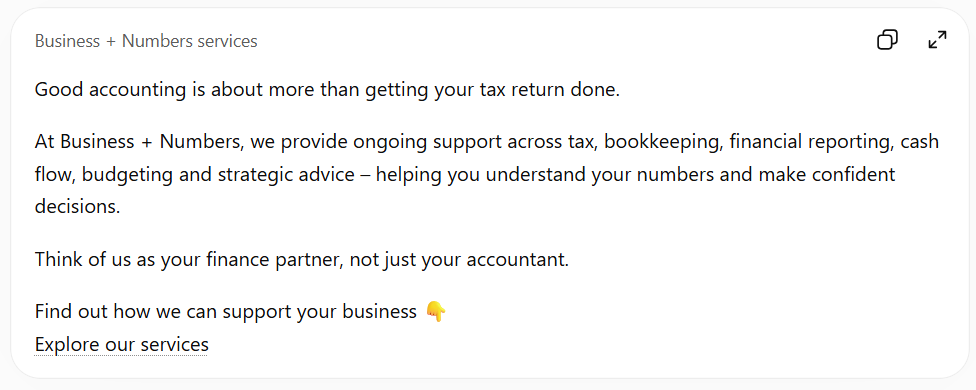
This is fine. But it’s generic. It doesn’t have a clear audience and isn’t impactful. It’s a prototype, not the finished product.
So, what should you do next?
Collaborate with AI, take a red pen to the caption and ultimately ask “So what?”
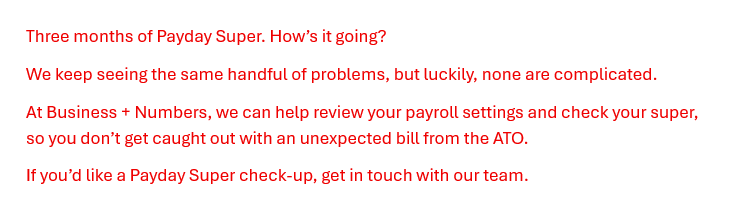
The easier it becomes to create something, the easier it becomes to create something that doesn’t really need to exist. When the production of the work becomes easier, the thinking behind the work matters more.
So what?
Asking “So what?” is about trying to make your work better.
It’s about lifting quality, reducing rework and creating work for impact. It’s about giving the person creating the piece enough context to make good decisions and giving the person reviewing it enough context to challenge those decisions.
Most importantly, it’s about not being satisfied simply because something is finished, accurate or technically correct. Ask why it exists. Challenge the work against that why. And keep asking:
So what?
2+2 will always equal 4. Whether that’s useful is up to you.
If you’re producing something and hoping it works, “So what?” is a useful framework that makes you stop hoping and start thinking, helping you create work for impact. Sometimes a fresh perspective can make all the difference. Our team at Focused can help sharpen the thinking and make sure your work is making the impact it should.