
The AI disruption and its impact on businesses
Four years ago this month, ChatGPT launched and kicked off a wave of AI disruption. Today, OpenAI says 1.2 billion people use it every week.
AI is rapidly changing how businesses work and how buyers choose suppliers. Where Google’s blue links were once our bible, AI is quickly becoming the new go-to for finding information. So, the next time a buyer needs a new supplier, there’s a good chance they might not start with a Google search.
Their first conversation could be with AI.
Instead of searching google, they might ask: “Who are the best engineering consultancies in Brisbane? Which ones have rail experience? What do their clients say about them?”
Within seconds, they’ll have a shortlist. Whether your business makes the list depends on the decisions you’re making right now.
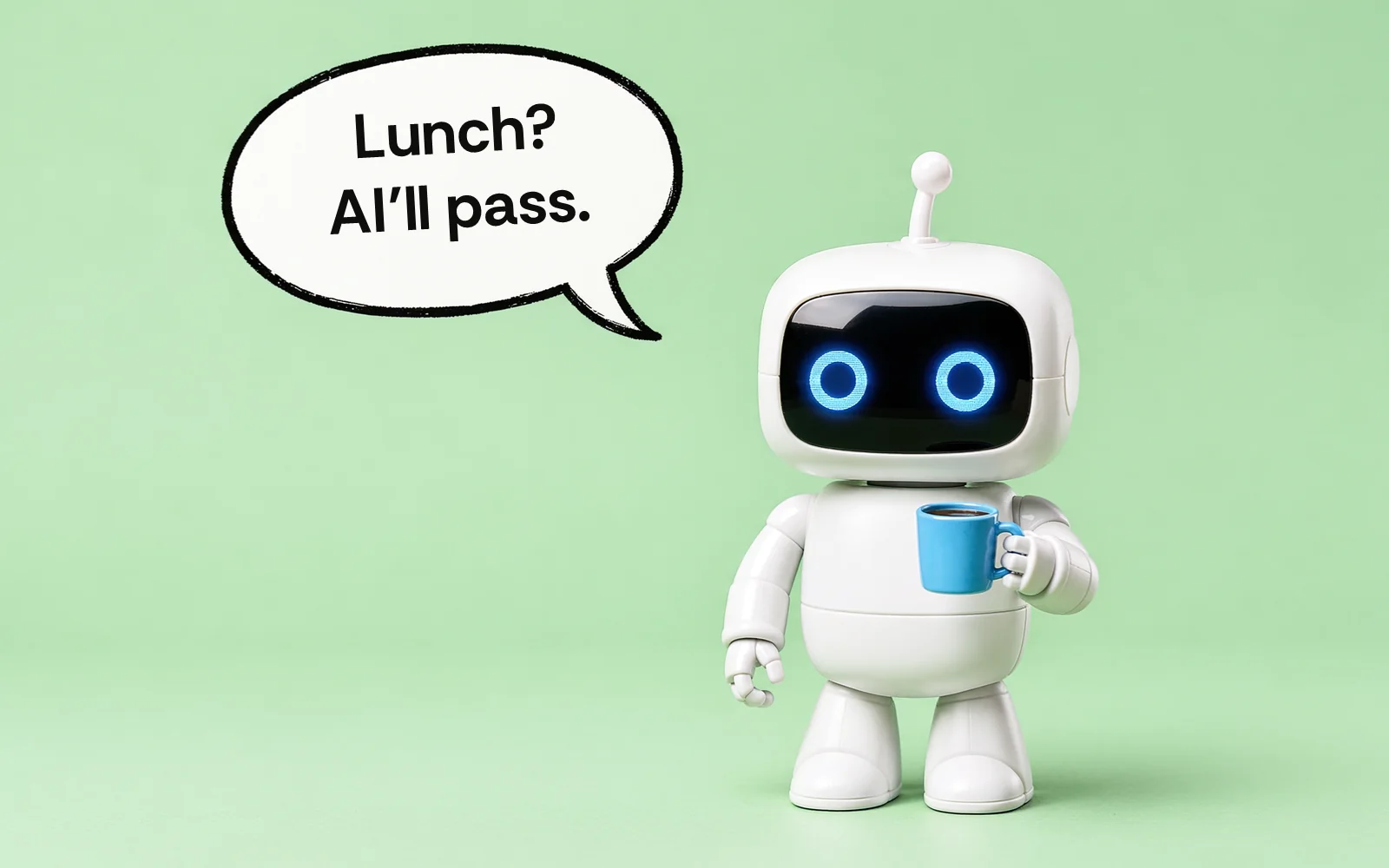
Because AI isn’t going away. It’s become the colleague who never takes a lunch break. It’s always on, never tired and is increasingly weaving itself into consumer habits.
So, what’s changed since AI’s first burst onto the scene four years ago? Where is the impact being felt? And what does it mean for B2B businesses?
AI has moved from answering questions to doing the work
For most people, AI still means a chatbot: you ask it a question, and it gives you an answer. The biggest shift now is the rise of AI agents.
What is an AI agent? An AI agent is AI that gets things done for you. Instead of just answering a question, you give it a task. It works out the steps and uses tools like a web browser, email or spreadsheets to finish the job on its own. That’s what “agentic” AI means: AI that can act independently, deciding what to do next instead of waiting to be told at every step.
Here’s a simple comparison of a Chatbot and an AI agent:
| Chatbot | AI agent | |
| You give it | A question | A goal |
| How it works | One reply, then it waits | Plans the steps and works through them |
| It can use | Only what’s in the chat | The web, files and business software |
| What you get | Text to copy and paste | Finished drafts, files and actions |
Compared to other countries, Australia is still at the start of this shift. CPA Australia’s 2026 Business Technology Report found 88% of Australian businesses use AI, but only 10% have embedded it deeply across their operations. And just 28% use agentic AI, compared with 58% in the Chinese Mainland.
As Gavan Ord of CPA Australia puts it:
“[Businesses] must move beyond AI experimentation and focus on embedding it more deeply into their operations… if Australia is serious about lifting productivity and improving economic growth.”
The impact of AI is very real
AI is advancing across almost every industry, and some of its biggest breakthroughs are happening well outside of marketing. Here’s a look at what it’s learning to do:
It’s getting better at spotting what humans might miss
Health: In Sweden, more than 105,000 women took part in the MASAI breast screening trial. With AI supporting radiologists, screening found 29% more cancers and cut the reading workload by 44%, with no rise in false alarms. Final results published this year also found 12% fewer cancers were detected between screening rounds, suggesting AI helped identify more cancers earlier.
It’s tackling increasingly complex problems
Science: Every protein in the body has a 3D shape, and mapping a single one takes years of lab work. Google DeepMind’s AlphaFold used AI to predict how it folds into its 3D structure. It has now predicted 200 million protein structures from over a million organisms, helping scientists accelerate research into everything from disease to drug development. Its creators shared the 2024 Nobel Prize in Chemistry.
It’s becoming a more sophisticated problem-solver
Maths, close to home: In July 2025, the International Mathematical Olympiad was held on the Sunshine Coast. For the first time, AI models from Google DeepMind and OpenAI reached gold-medal standard, solving five of the six problems. The models demonstrated how far AI’s reasoning skills have advanced by solving complex mathematical problems once considered beyond its reach.
It’s creating content most people can’t tell from the real thing
Music: In mid-2025, an indie rock band called The Velvet Sundown racked up more than a million monthly listeners on Spotify in a matter of weeks. Then it admitted the truth: the band didn’t exist. The songs, the band members and even their photos were all made with AI.
It wasn’t a one-off. In a blind listening test of 9,000 people across eight countries, 97% couldn’t tell AI-generated music apart from music made by people. By late 2025, streaming service Deezer was receiving around 50,000 fully AI-generated tracks every day, about a third of all new uploads.
Together, these breakthroughs offer a glimpse of just how advanced AI is becoming. And while your business might not be mapping proteins, diagnosing cancer or releasing albums, imagine what this level of technological progress could mean for the way you work.
Your customers are already using AI
For B2B businesses, this is the disruption closest to home. Buyers are increasingly turning to AI to research suppliers and inform their purchasing decisions.
Responsive’s Inside the Buyer’s Mind research found 90% of buyers do their research before they ever contact a supplier. Nearly two-thirds now use generative AI as much as, or more than, traditional search when researching suppliers.
How users search on Google is also changing. When an AI summary is shown at the top of search results, people are less likely to click through websites. Pew Research found users clicked a traditional search result in 8% of visits, compared with 15% when no AI summary appeared. Just 1% clicked a link within the AI summary.
Search queries themselves are also becoming more detailed. Google says the average search in its AI Mode is three times longer than a traditional search. Instead of typing a few keywords, people ask full questions – the way they’d ask a colleague. That means buyers can describe exactly what they need and means businesses with websites that clearly answer those questions are more likely to be recommended.
Being found is ultimately no longer the same as being clicked.
We unpacked what that means for your visibility in Has AI changed how customers find your business?
How fast is this moving?
AI isn’t just getting more popular. It’s getting more capable, and faster than most people realise. Two examples show just how quickly things are moving.
It spread faster than any app before it
When ChatGPT launched in November 2022, it reached an estimated 100 million users in just two months. Analysts at investment bank UBS said they couldn’t remember a consumer app growing that fast. Here’s how long some household names took to reach the same milestone:
| App | Time to reach 100 million users |
| 2.5 years | |
| TikTok | 9 months |
| ChatGPT | 2 months |
It went from laughable to lifelike in two years
In March 2023, an AI-generated video of actor Will Smith eating spaghetti went viral for all the wrong reasons. His face morphed from frame to frame and the pasta barely made it to his mouth. Will Smith even posted his own parody.
Two years later, when Google released its Veo 3 video tool, people recreated the same scene. This time it was close to lifelike, with natural movement and even chewing sounds. The clip has since become the internet’s unofficial yardstick for how fast AI is improving.
Why should you care? If AI can go from comical to convincing in two years, imagine where it will be by the time you next refresh your website or marketing plan. The tools your competitors and customers use will keep getting better, and faster.
Will AI take our jobs?
The good answer is no, not necessarily. A national study by Jobs and Skills Australia found generative AI is more likely to change how people work than replace them altogether. In many cases, AI will support employees by taking on certain tasks, helping with decision-making and improving efficiency.
However, the study did warn that AI may displace people in some jobs, and that the impact will vary across occupations, industries and regions. For most businesses, the bigger change is in how work gets done, not whether it gets done by people.
What does this mean for B2B businesses?
1. Your shortlist is being decided earlier
More research now happens before a buyer visits your website or picks up the phone. If your business isn’t clear and credible online, you may not make the list.
- Ask yourself: If a buyer asked AI to recommend a supplier in your field, would your business come up?
- Our recommendation: Make sure your website explains what you do, who you help and where you work within ten seconds of landing on it, in plain language that answers the questions buyers ask.
2. Polished content is easy, so you start sounding like everybody else
When anyone can produce a tidy blog in minutes, what stands out is what can’t be copied: real expertise, real projects and real people.
- Ask yourself: Does your content say something only your business could say?
- Our recommendation: Lead with your own experience: the projects you’ve delivered, the problems you’ve solved and the people who did the work. Our article Two + two = four. So what? provides insight into how to create work for impact.
3. Proof matters more than ever
Buyers check what AI tells them, and they’ll check you too.
- Ask yourself: Can buyers easily find real proof of your work: case studies, results and reviews?
- Our recommendation: Keep your case studies, testimonials and Google reviews current and easy to find on your website.
4. Your details need to be right everywhere
AI pulls information from across the web, not just your website. If your details are out of date somewhere, that may be what buyers see.
- Ask yourself: Is your information current everywhere buyers look?
- Our recommendation: Check your website, Google Business Profile, LinkedIn page and industry directories, and make sure they all say the same thing.
5. The shift is far from over
With 88% of businesses using AI but only 10% embedding it deeply, expect your industry to look different in two years’ time.
- Ask yourself: When did you last look at how your business shows up online?
- Our recommendation: Make it a regular check, not a one-off. Every few months, search for your business and your services the way a buyer would.
Some things still need a person
AI is changing how work gets done and how buyers find suppliers. It isn’t changing what they’re looking for: experienced, trustworthy partners who understand their problems.
AI can build a shortlist in seconds. It can’t sit across the table from a client, read the room or earn their trust over years.
AI never takes a lunch break. But your best clients still want to have lunch with you.
Want to make sure your business is the one buyers find, and choose? Talk to our team about sharpening your positioning, website and visibility.